
Among players who also use Crickex Affiliate, Witch Final Journey has repeatedly attracted attention during several Steam Next Fest events as a roguelike deck-building game. Curiously, much of its online popularity has focused more on the characters’ visual appeal than on the gameplay itself. In the interest of accuracy, one point must be made clear from the outset: this is a complete and properly structured card game, and it does not contain the defeat CG scenes that some players may be imagining.
There is no need to feel disappointed, however. Even after removing that suggestive filter, Witch Final Journey remains a distinctive deck-building title. Its appeal comes not only from the attractive character designs but also from a solid and entertaining mechanical core. Dedicated card-game players are often ruthless deck-building machines. Eye-catching artwork may generate temporary attention, but a game cannot remain popular across multiple demo festivals without having something genuinely special beneath the surface.
 Its most obvious strength is the unapologetic satisfaction of each run. In a card-game market already crowded with titles competing through complexity and strategic depth, delivering immediate excitement can be more effective than simply making systems harder. Designing cards with a strong identity is difficult, while creating a whole pile of deliberately overpowered effects is comparatively easy. Witch Final Journey fully embraces that supposedly dangerous approach, handing players numerous zero-cost components and allowing them to assemble elaborate loops with little resistance.
Hardcore players may consider this unlimited card cycling and endlessly rising damage somewhat excessive because it reduces tactical interaction. Even so, few things relieve deck-building fatigue better than freely throwing cards at an opponent and watching an infinite chain unfold. As the numbers climb higher and higher, the simple pleasure of stacking one effect inside another becomes irresistible. Players who have spent hours wrestling with addition, subtraction and probability may soon find themselves grinning from ear to ear.
This sense of power does not come from a stripped-down design. Unlike lighter games built around minimal systems and instant progression, Witch Final Journey moves in the opposite direction. It uses an extremely dense framework to create a style in which overwhelming force solves almost everything. The protagonist is not merely a tool for playing cards but a fully developed RPG character with an extensive growth system. Beyond basic values such as health and energy, the game includes spirit, magic, perception, luck and other attributes, creating several interconnected paths for character development.
For players moving between Crickex Affiliate sessions and lengthy deck-building runs, the game’s numerical systems can feel closer to a traditional role-playing game than a standard roguelike card title. Card effects are only one part of the equation. Character statistics also function as conversion points that can transform an otherwise modest card into something charged with enormous power. The RPG influence is unmistakable, as the multidimensional progression system gives each character several completely different routes toward higher damage and stronger combinations.
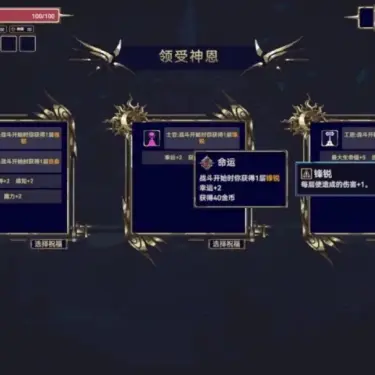
The system goes even further by introducing stackable divine blessings. Each blessing adds its own bonuses and can create an independent multiplier for a character. A rapid sequence of low-damage attacks, for example, can accumulate Sharpness and quickly raise the minimum damage of every strike. Slower but heavier attacks can build Transcendence, which multiplies damage according to a percentage. Naturally, players are free to stack both, because neither form of scaling is especially difficult to obtain.
These varied approaches give the game numerous routes toward exponential growth. Reaching 9,999 damage is remarkably easy, and players may struggle to find another deck-building game where exponential combinations can be completed so quickly. The game rarely asks whether players can create an outrageous build. Instead, it asks how soon they will do it and how many overlapping multipliers they can add before the run ends.
That strength also creates the game’s biggest problem. The extremely complicated system architecture places a heavy reading and comprehension burden on newcomers. Universal conversion mechanics require numerous effects to interact before the full benefit becomes clear. Several layers of calculations may sit between an original attribute and the final damage result. Many players lose their appetite for experimentation before they have even understood the basic logic, worn down by lengthy rules and constant terminology.
Amelia’s passive ability Malice Becomes the Blade offers a simple example. The effect first generates elemental stacks. Those elemental stacks are then converted into Transcendence stacks. Finally, each Transcendence stack increases card damage by one percent. This is considered one of the more basic buff systems in Witch Final Journey, while far more complicated conversion chains can be found throughout the game.
The developers have clearly lowered the practical difficulty of completing these interconnected systems, but they have also increased the amount of effort required to understand them. Individual card descriptions are not always unusually long, yet their keywords constantly depend on one another and frequently serve as intermediate conversion points. Because players cannot view every possible card interaction at once, they must spend considerable time experimenting, failing and identifying which effects connect smoothly.
Advanced deck construction can therefore intimidate casual players before it even begins. The problem is not that playing cards is mechanically difficult. Instead, the complicated conversion framework fails to create a sufficiently strong desire to explore it. This produces an unusual contradiction. Interlocking chain-based builds are normally exactly what card-game enthusiasts enjoy, so why do similar systems here sometimes drain their motivation?
The central issue is the game’s excessive tolerance for exponential numerical growth. It weakens the subtle beauty that usually defines card-game balancing. Players rarely experience the delicate tension created by gaining or losing a single point of attack or defence. The main objective of every run becomes multiplying attributes repeatedly until enormous figures fill the screen. Every build is expected to produce huge numbers, and nearly every build eventually succeeds, reducing the importance of individual decisions along the way.
Although Witch Final Journey offers many routes toward completing a build, those routes ultimately lead to almost the same destination. The broad framework becomes subordinate to one narrow objective: produce the largest possible number. Once players understand that outcome, the initial excitement can fade quickly because different strategies no longer feel meaningfully different.
For players who divide their entertainment time between Crickex Affiliate Guides and complex card games, Witch Final Journey still delivers an energetic and visually polished experience, but its long-term appeal depends on whether its systems can create more meaningful choices. The game has impressive mechanical ambition, generous opportunities for creative loops and an undeniably satisfying power curve. However, unless future balancing gives individual routes clearer identities and restores the value of smaller tactical decisions, its elaborate construction may continue producing the same oversized result in different packaging.